Nebraska's Best Destinations & Attractions

From monumental geological landmarks to world-class cities, Nebraska's diverse destinations reward every kind of traveler. Here is your definitive guide to the places that define the Cornhusker State.

What Makes Nebraska's Destinations Unique?

Nebraska's travel landscape is defined by extraordinary contrasts β€” vast open prairies and cosmopolitan cities, ancient geological formations and modern cultural venues, quiet wilderness and roaring stadium crowds.

Nebraska is a state of superlatives that few outside its borders fully appreciate. It is home to the world's largest contiguous sand dune formation in the temperate world, one of the most dramatic springtime wildlife spectacles on the planet, the nation's best-ranked public zoo, and one of the most architecturally significant state capitol buildings in the entire country.

The geographical diversity within Nebraska's 77,358 square miles is remarkable. Drive from the Missouri River bluffs of Omaha westward to the sculptured sandstone badlands of Toadstool Geological Park, and you will cross terrain so varied it seems impossible that it exists within a single state's borders. Each geographic region offers its own distinctive travel experience, its own cultural heritage, and its own natural wonders.

Nebraska's destinations are also deeply accessible. Unlike many western states where major attractions require long, difficult approaches, Nebraska's landmarks are generally reachable by standard passenger vehicles. The state's extensive highway network, reasonable gas prices, and affordable lodging make it one of the most budget-friendly road trip destinations in the country.

Perhaps most importantly, Nebraska offers the increasingly rare pleasure of visiting destinations that have not yet been loved to death. You can stand at the summit of Scotts Bluff on a weekday morning and be utterly alone with the wind, the sky, and the ghost of a hundred years of pioneer longing. You can paddle the Niobrara River through a canyon of waterfalls and limestone without fighting crowds. You can photograph the crane migration from the banks of the Platte without jostling for position with a thousand other photographers.

That authentic, uncrowded quality makes Nebraska's destinations genuinely special. These are places where the experience, not the Instagram moment, is still the point β€” and that distinction is becoming rarer and more valuable with every passing year.

πŸ—ΊοΈ Planning Your Route

Nebraska is 430 miles wide and 210 miles tall. Interstate 80 runs the full east-west length, while US Highway 20 provides a spectacular northern corridor. Plan at least 5–7 days to meaningfully explore both eastern cities and western landmarks.

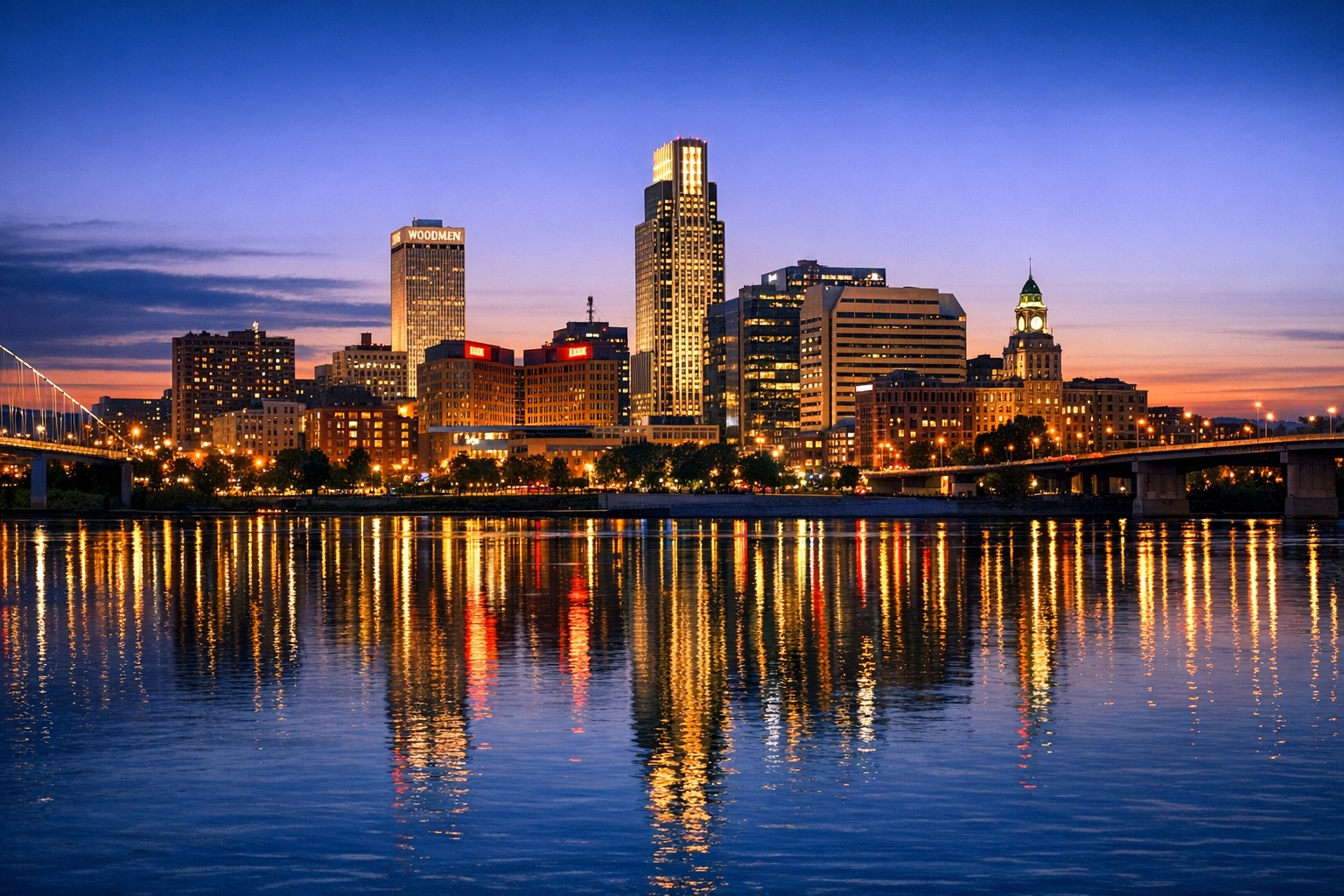
Omaha Nebraska downtown skyline at dusk reflected in the Missouri River

Omaha – Nebraska's Cultural Capital

Omaha, Nebraska's largest city with a population approaching half a million, is a genuinely world-class destination that consistently astonishes first-time visitors. It is a city of enormous vitality, cultural ambition, and culinary sophistication β€” one that has shed any trace of inferiority complex to emerge as one of the Midwest's most compelling urban experiences.

The city's economic foundation is remarkably robust. Omaha is headquarters to five Fortune 500 companies β€” including Berkshire Hathaway, led by the legendary investor Warren Buffett β€” and is a global center for the insurance, telecommunications, and financial services industries. This economic strength supports a cultural infrastructure that punches significantly above the city's weight class.

The Old Market entertainment district, spread across several blocks of beautifully restored late-Victorian warehouse and commercial buildings in the downtown core, is the undeniable heart of Omaha's social life. Its red-brick streets are lined with galleries, boutiques, independent restaurants, craft cocktail bars, jazz venues, and specialty food purveyors. On warm evenings, the district hums with energy from the cobblestone courtyards to the rooftop terraces.

  • βœ“Henry Doorly Zoo: Consistently ranked #1 zoo in America with 130+ acres
  • βœ“Old Market District: Dining, galleries, boutiques in historic brick buildings
  • βœ“Joslyn Art Museum: World-class collection, free Sundays
  • βœ“Durham Museum: History museum in stunning Art Deco train station
  • βœ“Lauritzen Gardens: 100-acre botanical garden on the Missouri River bluffs
  • βœ“Strategic Air & Space Museum: Massive collection outside Ashland

Henry Doorly Zoo & Aquarium – The World's Best Zoo

No visit to Omaha is complete without a full day at the Henry Doorly Zoo and Aquarium, which has been ranked the number-one zoo in the United States by TripAdvisor and USA Today on multiple occasions and consistently appears in international top-ten zoo rankings. The zoo's 130 acres house over 17,000 animals representing 962 species, displayed in some of the most innovative habitat designs in the world.

The Lied Jungle, a 1.5-acre indoor rainforest built inside what was once the world's largest glazed geodesic dome, recreates ecosystems from South America, Africa, and Asia. The Desert Dome opposite it β€” the world's largest indoor desert β€” shelters the remarkable biodiversity of three of the world's great desert regions under its enormous glass shell. The aquarium features a 70-foot shark tunnel and floor-to-ceiling viewing windows into tanks holding sharks, rays, and thousands of fish. The nocturnal cave exhibit allows visitors to observe species rarely displayed anywhere else in the world.

The zoo's commitment to conservation is matched by its ongoing research programs, which have achieved internationally recognized breakthroughs in assisted reproduction for endangered species. Budget a full day for a thorough visit, arrive early to avoid crowds, and consider the zoo membership for unlimited returns during an extended stay.

Joslyn Art Museum

The Joslyn Art Museum stands as one of the most underappreciated art institutions in the United States. Housed in a stunning 1931 Art Deco marble building that was expanded with an award-winning glass addition by Norman Foster Associates in 1994, the Joslyn holds an encyclopedic collection spanning ancient Egyptian artifacts to contemporary American art. Its particular strengths lie in 19th and early 20th century American and European works, with exceptional pieces by Monet, Renoir, Cassatt, and Remington.

The museum's Karl Bodmer collection is unique in the country β€” over 400 watercolor studies of Native American peoples and Great Plains landscapes produced by the Swiss artist during the Prince of Wied Expedition of 1832–34. These works constitute an irreplaceable visual record of a world that was about to be transformed beyond recognition. Admission is free on Sundays, making the Joslyn accessible to all visitors regardless of budget.


Young woman enjoying coffee at an outdoor cafe in Lincoln Nebraska Old Market

Lincoln – The City of Progress

Lincoln, Nebraska's capital city and home to the University of Nebraska, is one of the most livable and energetic mid-sized cities in the United States. With a population of approximately 300,000, it combines the cultural richness and dining diversity of a major university town with the accessibility and affordability of a Midwest city that hasn't yet been discovered by the rest of the world.

The Nebraska State Capitol building, completed in 1932, is Lincoln's most iconic landmark and one of America's architectural treasures. Unlike the classical domes that characterize most state capitols, the Nebraska building features a soaring Art Deco tower rising 400 feet above the plains β€” visible for miles in every direction and topped by a bronze sculpture called "The Sower." The interior mosaics, painted murals, and stone carvings celebrate Nebraska's history and culture with extraordinary artistry and ambition.

The Haymarket district, just west of downtown, is Lincoln's vibrant hub of independent restaurants, coffeehouses, craft breweries, live music venues, and specialty shops. The Saturday Haymarket Farmers' Market, running spring through fall, draws thousands of Lincoln residents and visitors to browse fresh produce, local cheeses, artisan breads, and handmade crafts in one of the Midwest's finest open-air market experiences.

  • βœ“Nebraska State Capitol: Magnificent Art Deco tower, free tours available
  • βœ“Haymarket District: Dining, shopping, farmers' market, craft breweries
  • βœ“Sheldon Museum of Art: University collection with nationally significant works
  • βœ“Nebraska History Museum: Comprehensive state history from prehistoric to present
  • βœ“Sunken Gardens: Beautiful formal gardens in the heart of Lincoln
  • βœ“Pioneers Park: 668-acre nature reserve with bison and elk

Chimney Rock – Beacon of the Oregon Trail

Chimney Rock National Historic Site is arguably the single most recognizable natural landmark in Nebraska, and one of the most historically significant geological formations in the entire American West. Rising 325 feet above the surrounding plain in the western Nebraska Panhandle near the town of Bayard, Chimney Rock's distinctive spire is the result of millions of years of erosion working on alternating layers of volcanic ash and clay that were deposited by ancient rivers and winds.

For the estimated 400,000 pioneer emigrants who traveled the Oregon, California, and Mormon Pioneer trails between the 1840s and 1860s, Chimney Rock was far more than a geological curiosity. It was a landmark, a morale marker, and a symbol of how far they had come β€” and how far they still had to go. Dozens of emigrant diaries mention the rock with excitement, relief, or wonder, making it one of the most documented geological features in 19th century American literature.

The National Park Service visitor center at Chimney Rock offers excellent interpretive exhibits tracing the geology of the formation and the history of the trails that passed by it. The center features authentic artifacts from the overland trail period, interactive exhibits suitable for families, and a well-stocked bookstore with trail history publications. Rangers offer guided programs during the summer months.

Visiting Chimney Rock today is a genuinely moving experience. The formation remains a powerful presence on the landscape, visible from many miles away as you drive west along Highway 92. Standing at the base and looking up at the eroded spire against an enormous Nebraska sky, it is not difficult to understand why this landmark so affected the thousands of emigrants who gazed at it from their wagon seats after weeks of hard travel across the featureless plains.

The best time to photograph Chimney Rock is at golden hour β€” either early morning or in the final hour before sunset β€” when the low-angle light dramatically emphasizes the formation's textures and the surrounding landscape glows with warm color. The prairie surrounding the monument is excellent for wildflower photography in late spring and early summer, when native grasses and flowers frame the rock in color.

πŸ“ Practical Information

Chimney Rock is located 6 miles south of Bridgeport, Nebraska on Highway 92. The visitor center is open daily. A small admission fee is charged. The formation itself is closed to climbing to preserve the fragile geology.

Nearby attractions include Scotts Bluff National Monument (25 miles west), the Oregon Trail Museum, and the charming small town of Scottsbluff with its Main Street shops and the excellent Western Nebraska Community College arts facilities.

Young woman hiking at Scotts Bluff National Monument Nebraska

Scotts Bluff – Gateway to the Rocky Mountains

Scotts Bluff National Monument, located just southwest of the city of Scottsbluff in the western Nebraska Panhandle, is one of the most dramatic and historically significant landscapes in the Great Plains. The monument encompasses a series of spectacular bluffs and rock formations that rise up to 800 feet above the North Platte River valley, their eroded towers and pinnacles creating a skyline that seems more appropriate to the American Southwest than the seemingly endless Nebraska plains.

The monument takes its name from a fur trapper named Hiram Scott who died in the vicinity in 1828, and whose fate β€” whether abandoned by companions or lost while injured β€” became one of the enduring legends of the early fur trade era. By the 1840s, the bluffs had become a key landmark for Oregon Trail emigrants, who navigated Mitchell Pass β€” a narrow gap through the rock formations that allowed wagons to pass β€” as part of their long journey westward.

Today, Scotts Bluff offers 6 miles of hiking trails ranging from easy valley walks to a moderately challenging summit trail that rewards hikers with panoramic views extending into Wyoming and Colorado on clear days. An auto road also provides vehicle access to the summit for those unable to hike. The visitor center houses the William Henry Jackson Collection, a remarkable archive of photographs, watercolors, and original Oregon Trail artifacts of national significance.

  • βœ“6 miles of hiking trails including summit access
  • βœ“Panoramic views into Wyoming and Colorado from the summit
  • βœ“William Henry Jackson Collection at the visitor center
  • βœ“Original Oregon Trail wagon ruts still visible
  • βœ“Exceptional spring wildflower displays

The Nebraska Sandhills – America's Hidden Wilderness

The Nebraska Sandhills constitute one of the most remarkable and least-visited landscapes in North America. Covering approximately 19,300 square miles β€” nearly a quarter of Nebraska's total land area β€” the Sandhills are the largest sand dune formation in the Western Hemisphere: a vast, undulating sea of grass-stabilized dunes stretching across 20 counties in north-central Nebraska.

Unlike desert dunes, the Nebraska Sandhills are thoroughly clothed in native grasses, wildflowers, and woody shrubs that anchor the underlying sand in place. Beneath the surface, the dunes sit atop the Ogallala Aquifer, the vast underground water reservoir that underlies much of the Great Plains. This combination of deep sand and high water table creates thousands of interdunal wetlands β€” lakes, ponds, and marshes fed by groundwater seeping to the surface β€” that support extraordinary biological diversity.

The Sandhills host an avian richness that astonishes ornithologists and birding enthusiasts. The region's wetlands provide critical habitat for migrating waterfowl, whooping cranes, and shorebirds. Fort Niobrara National Wildlife Refuge, located near Valentine in the heart of the Sandhills, protects bison, elk, longhorn cattle, and prairie dogs in their native habitat and offers visitors the remarkable experience of watching these native animals in a setting virtually unchanged from the 19th century.

The Sandhills are perhaps most extraordinary after dark. Cherry County, the largest county in Nebraska by area and located entirely within the Sandhills, has one of the darkest nighttime skies in the eastern United States. On clear nights, the Milky Way blazes across the sky with a clarity and brilliance that is genuinely shocking to visitors accustomed to light-polluted urban skies. The Bessey Ranger District of the Nebraska National Forest, near Halsey, offers basic campground facilities that put visitors under some of the best stargazing skies available east of the Rocky Mountains.

The Sandhills are also Nebraska's most authentically western cultural landscape. The region's economy has been based on cattle ranching since the 1880s, and the Sandhills cowboy culture β€” with its particular combination of stoicism, self-reliance, and genuine hospitality β€” is alive and well in communities like Valentine, Ainsworth, and Mullen. Visitors who take the time to stop in these small towns, chat with locals, and attend a rodeo or community event will encounter a way of life that is simultaneously vanishing and stubbornly persistent.

🌟 Sandhills Highlights

Valentine is the gateway to the Sandhills. The Niobrara National Scenic River flows through the region, offering excellent canoe and kayak paddling through a canyon landscape of waterfalls and limestone walls. Summer float trips on the Niobrara are among Nebraska's most popular outdoor recreation experiences.

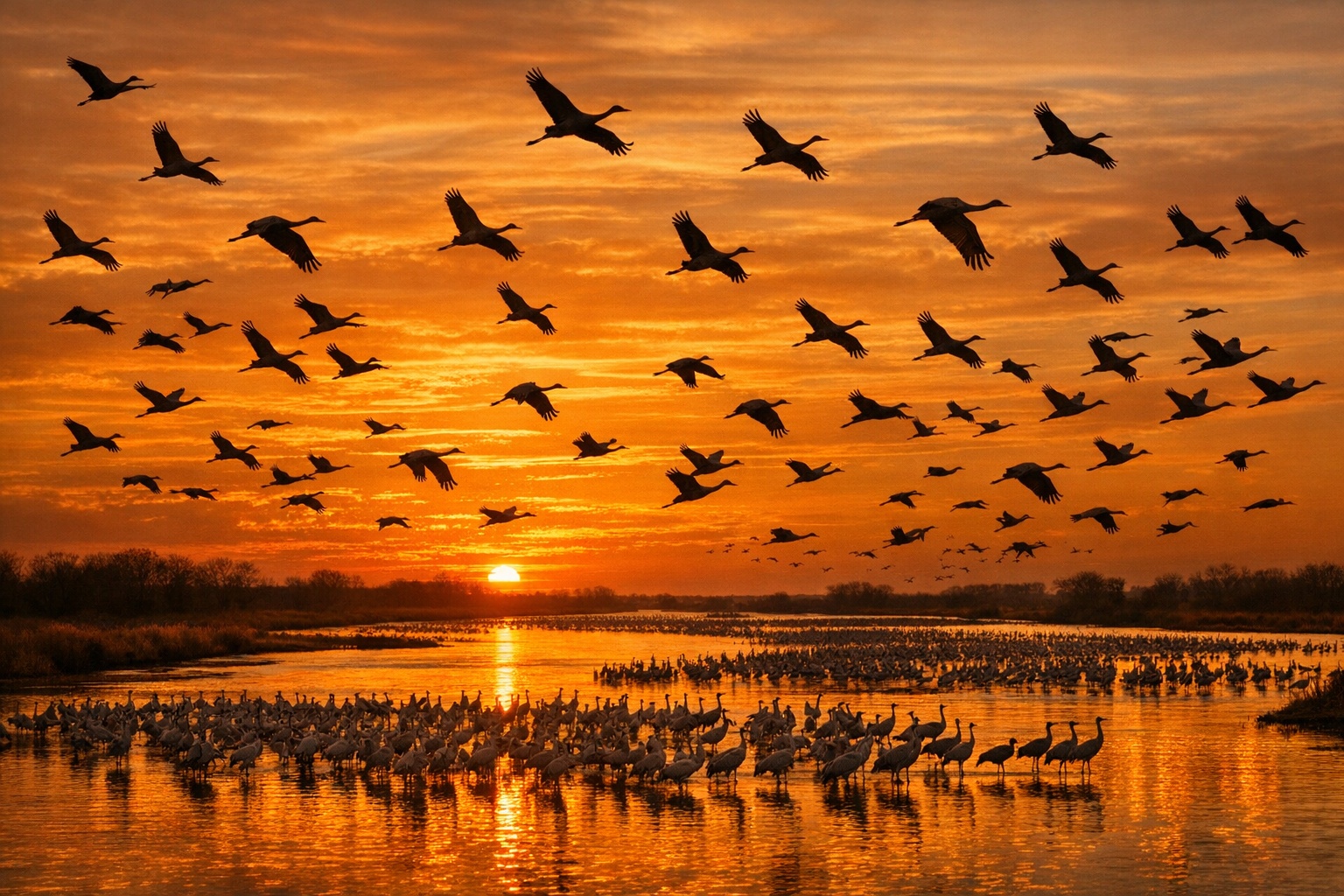
Thousands of sandhill cranes in flight at sunset over the Platte River Nebraska

Platte River Crane Migration

Each spring, one of the world's most spectacular wildlife events unfolds along a 70-mile stretch of the Platte River near Kearney, Nebraska. Between late February and mid-April, nearly half a million sandhill cranes β€” representing 80% of the world's entire population β€” descend on the river's shallow braided channels and adjacent cornfields to rest and feed during their northward migration to Canadian and Alaskan breeding grounds.

The scale of the event is almost incomprehensible to those who have not witnessed it. In the early morning and at sunset, vast flocks of cranes lift off from the river in coordinated masses, their prehistoric calls filling the sky with a sound that carries for miles. The sky literally darkens with birds. The sound is unlike anything else in nature β€” a deep, rattling bugle that seems to come from every direction simultaneously, resonating in the chest as much as the ears.

The Rowe Sanctuary operated by the National Audubon Society near Gibbon, Nebraska offers the premier crane-watching experience, with heated blind facilities on the river's edge that put observers mere feet from roosting cranes at dawn and dusk. Reservations are essential and should be made months in advance for peak-season visits in mid-March. The Crane Trust Nature and Visitor Center east of Grand Island provides additional interpretation and viewing opportunities.

  • βœ“Peak season: Mid-March through early April
  • βœ“Best viewing: Sunrise and sunset at river blinds
  • βœ“Location: Kearney and Grand Island area, central Nebraska
  • βœ“Species: Sandhill cranes, whooping cranes, snow geese
  • βœ“Book ahead: Rowe Sanctuary blinds fill months in advance

More Nebraska Destinations at a Glance

Nebraska offers dozens of additional worthwhile destinations beyond its headline attractions. Here's a curated overview of other must-visit places across the state.

Destination Region Type Highlight
Toadstool Geological Park Northwest Panhandle Geological Otherworldly eroded badlands formations; fossil hunting
Lake McConaughy West-Central Recreation Nebraska's largest lake; sandy beaches, sailing, fishing
Niobrara National Scenic River North-Central Waterway Canoe/kayak canyon trip; waterfalls; wildlife
Fort Robinson State Park Panhandle Historic Park Historic cavalry fort; bison herd; jeep rides
Indian Cave State Park Southeast State Park Prehistoric cave art; hiking; Missouri River views
Ponca State Park Northeast State Park Missouri River overlooks; mountain biking; camping
Stuhr Museum Grand Island Living History Railroad Town living history museum; steam trains
Harold Warp Pioneer Village Minden Museum Enormous collection of Americana; antique machinery
Nebraska National Forest Bessey/Halsey Forest Hand-planted forest; camping; dark sky stargazing
Museum of Nebraska Art Kearney Museum Comprehensive collection of art by Nebraska artists

Eastern Nebraska: River Bluffs & River Towns

Eastern Nebraska, shaped by the Missouri River and its tributaries, offers a distinctly different travel experience from the wide-open western plains. The Missouri River bluffs here are dramatic and forested, the small river towns retain 19th-century downtown architecture of considerable charm, and the cultural landscape reflects both Native American heritage and the legacy of German, Czech, and Scandinavian immigration.

Plattsmouth, Brownville, Nebraska City, and Nebraska City's Arbor Lodge State Historical Park β€” the home of Julius Sterling Morton, founder of Arbor Day β€” offer excellent heritage tourism in a compact corridor accessible from Omaha. The Lewis and Clark National Historic Trail passes through this region, and several interpretive sites along the Missouri illuminate the Corps of Discovery's journey with exceptional scholarship and design.

Indian Cave State Park, near Shubert in the extreme southeastern corner of Nebraska, preserves a remarkable limestone cave containing prehistoric petroglyphs β€” carvings made by inhabitants of the region perhaps 800 years ago. The park's 3,052 acres of bluff-top forests and river-bottom woodlands offer some of Nebraska's best autumn foliage and excellent white-tailed deer hunting in season.

Central Nebraska: Agriculture, History & Heritage

The central Platte River valley is Nebraska's agricultural heartland and one of its most historically layered landscapes. The towns of Kearney, Grand Island, and Hastings anchor a region of rolling farmland, river bottomlands, and vast irrigation systems that have transformed the semi-arid plains into some of the most productive cropland on earth.

Kearney is the cultural heart of central Nebraska, home to the University of Nebraska at Kearney, the Museum of Nebraska Art, the Archway Monument spanning Interstate 80 (a unique museum built over the highway to interpret the Oregon Trail and the history of US overland travel), and the extraordinary World War II-era Fort Kearny State Historical Park. The Kearney area is, of course, also the premier base for experiencing the world-famous crane migration each spring.

Grand Island, Nebraska's third-largest city, hosts the Nebraska State Fair β€” one of the nation's oldest and largest state fairs, established in 1868 and drawing over 300,000 visitors each year during its late-August/early September run. The fair is a genuine celebration of Nebraska's agricultural heritage, featuring livestock shows, carnival rides, live music, rodeo competition, and an extraordinary parade of food vendors serving everything from proper Husker beef burgers to funnel cakes to locally crafted ice cream.

The Nebraska Panhandle: Where the West Begins

Western Nebraska's Panhandle region has more in common geographically and culturally with Wyoming and Colorado than with eastern Nebraska. The landscape becomes progressively more dramatic as you travel west, with elevations rising, rainfall decreasing, and the vegetation shifting from the lush grasses of the Sandhills to the sparse sagebrush and yucca of the high plains.

The Panhandle's geological diversity is spectacular. Toadstool Geological Park, near the town of Crawford, features an almost surreal landscape of mushroom-shaped rock formations, eroded pedestals, and badlands terrain that looks like a set from a science fiction film. The area is rich in fossils β€” an ancient lake bed exposed by erosion has yielded thousands of specimens β€” and serious fossil hunters can obtain permits for surface collecting.

Fort Robinson State Park, Nebraska's largest state park at 22,000 acres, occupies the site of a historic US Army cavalry post established in 1874 to monitor the treaty-confined Oglala Lakota people. The fort is most poignantly known as the place where the warrior Crazy Horse was killed in 1877 under circumstances that remain deeply contested. Today the park offers horseback riding, jeep tours, a bison herd, summer theatrical performances, and excellent camping facilities in historic adobe cavalry barracks.

Nebraska Destinations: Your Questions Answered

The Henry Doorly Zoo and Aquarium in Omaha is Nebraska's single most visited attraction, drawing over 1.5 million visitors annually. It is consistently ranked among the top zoos in the world for its innovative habitat designs, species diversity, and conservation work.
The sandhill crane migration peaks along the Platte River near Kearney between late February and mid-April, with the absolute peak typically occurring in the second and third weeks of March. The Rowe Sanctuary operated by the Audubon Society offers the best blind viewing and requires advance reservations.
Absolutely. Chimney Rock is one of the most historically significant and visually dramatic landmarks in the American West. The National Park Service visitor center provides excellent context, and the formation itself is a genuinely moving sight, particularly at golden hour when it glows against the Nebraska sky.
The Sandhills offer exceptional birding, dark-sky stargazing, fishing in hundreds of lakes, canoeing on the Niobrara River, hiking at Fort Niobrara National Wildlife Refuge, wildlife viewing (bison, elk, deer, thousands of bird species), and horseback riding on working cattle ranches that accept guests.
A comprehensive trip covering Omaha, Lincoln, the Platte River corridor, and the western Panhandle realistically requires 7–10 days. A shorter 4–5 day trip can cover either the eastern cities and central attractions or the western landmarks in satisfying depth. Even a weekend in Omaha alone is well worth the trip.

Plan Your Nebraska Adventure

Ready to explore the Cornhusker State? Our comprehensive travel guide has everything you need β€” from packing tips to seasonal itineraries.

View Travel Guide