Nebraska Travel Guide

Everything you need to plan the perfect Nebraska trip — seasonal guides, road trip routes, dining recommendations, accommodation options, packing tips, and insider knowledge from those who know the Cornhusker State best.

Young woman driving on an open Nebraska highway through the Great Plains

Nebraska: Made for the Road

Nebraska is, at its core, a road trip destination — a state that rewards the traveler who is willing to pull off the highway, drive down a gravel road, stop at an unexpected small-town diner, and let the journey itself become the destination. The state's excellent highway infrastructure, wide-open spaces, and the genuine hospitality of its people make Nebraska road trips among the most memorable in the American experience.

Nebraska's 93 counties span an enormous variety of landscapes, each with its own character and rewards. From the lush Missouri River bluffs of the east to the high, dry plains of the Panhandle, from the grass-covered dune valleys of the Sandhills to the canyon walls of the Niobrara River, the variety of Nebraska's geography ensures that no two stretches of highway look alike.

  • Interstate 80 spans the state east to west — 455 miles of easy access
  • US Highway 20 offers a stunning north-central scenic alternative
  • Minimal traffic outside major cities — open roads year-round
  • Gas prices consistently among the lowest in the nation
  • Friendly locals and authentic small-town hospitality at every stop
See Our Itineraries

Nebraska by Season

Nebraska's four distinct seasons each offer their own distinctive travel experiences. Understanding seasonal rhythms is the key to planning a trip that perfectly matches your interests and priorities.

🌸 Spring (Mar–May)

  • 🦅 Sandhill crane migration (peak: mid-March)
  • 🌸 Prairie wildflowers bloom statewide
  • 🎣 Excellent fishing season begins
  • 🚶 Ideal hiking temperatures
  • 🌦️ Variable weather; pack layers
  • ⭐ Best season for wildlife viewing

☀️ Summer (Jun–Aug)

  • 🏖️ Lake McConaughy at its best
  • 🎡 Nebraska State Fair (Aug–Sept)
  • 🏈 Huskers football season opener
  • 🎆 4th of July celebrations statewide
  • 🌡️ Hot; 80–95°F typical highs
  • ⭐ Peak season; book early

🍂 Fall (Sept–Nov)

  • 🍁 Spectacular river valley foliage
  • 🏈 College football — Huskers home games!
  • 🎃 Harvest festivals and county fairs
  • 🦌 Deer hunting season (October–December)
  • 🌤️ Perfect temperatures: 50s–70s°F
  • ⭐ Best overall travel weather

❄️ Winter (Dec–Feb)

  • 🎭 Omaha & Lincoln arts season peaks
  • 🎿 Skiing at Ski Hosts in Chadron
  • 🦅 Bald eagle viewing along the Platte
  • 🎄 Holiday events in major cities
  • ❄️ Snow and cold; below 0°F possible
  • ⭐ Lowest prices; fewest crowds

Nebraska Road Trip Itineraries

Whether you have a long weekend or two full weeks, these curated itineraries help you make the most of your time in the Cornhusker State.

4–5 Days

The Nebraska Essentials

Perfect for first-time visitors

  • Day 1–2: Omaha — Henry Doorly Zoo, Old Market, Durham Museum, Joslyn Art Museum
  • Day 3: Lincoln — State Capitol, Haymarket, University of Nebraska campus
  • Day 4: Kearney — Crane migration (spring) or Archway Monument
  • Day 5: Return via US 30 — Lincoln and Omaha shopping/dining

Approx. driving: 350 miles total. Ideal March–May for crane migration.

7–10 Days

The Full Nebraska Experience

For the thorough explorer

  • Days 1–2: Omaha and surroundings
  • Day 3: Lincoln and State Capitol
  • Day 4: Kearney crane migration / Platte River
  • Days 5–6: Sandhills via Valentine — Niobrara River canoe, stargazing
  • Day 7: Chadron and Fort Robinson State Park
  • Day 8: Toadstool Park, Scotts Bluff, Chimney Rock
  • Days 9–10: Return via I-80, North Platte, Grand Island

Approx. driving: 900 miles total. Best June–September or spring migration season.

Weekend

Omaha Urban Weekend

Perfect city break from anywhere in the Midwest

  • Friday evening: Old Market dinner and cocktails; explore the district
  • Saturday morning: Full day at Henry Doorly Zoo
  • Saturday afternoon: Joslyn Art Museum (free Sundays), Lauritzen Gardens
  • Saturday evening: Durham Museum, Old Market restaurants
  • Sunday: Brunch in Benson neighborhood, antique shopping, Farmer's Market

Ideal for: Foodie travelers, culture seekers, families with children.

Nature Focus

Nebraska Wilderness Route

For outdoor enthusiasts

  • Day 1: Drive to Valentine via US 20 from Sioux City
  • Day 2: Niobrara River canoe trip (half to full day); waterfalls
  • Day 3: Fort Niobrara Wildlife Refuge; bison viewing; Sandhills stargazing
  • Day 4: Bessey Ranger District Nebraska National Forest; hiking
  • Day 5: Lake McConaughy for water recreation
  • Day 6: Scotts Bluff summit hike; Chimney Rock; return east

Best May–September. Pack camping gear for maximum flexibility.

Nebraska State Fair at night with colorful Ferris wheel and carnival lights

Nebraska's Best Events & Festivals

Nebraska's event calendar is rich with festivals, fairs, and cultural celebrations that offer authentic windows into the state's diverse heritage and modern vitality. Planning your trip around one of these events can elevate a good Nebraska vacation into an unforgettable one.

The Nebraska State Fair, held each August and September in Grand Island, is the cornerstone of the state's event calendar. Established in 1868 — making it older than the state itself — the fair draws over 300,000 visitors with livestock shows, agricultural competitions, carnival rides, live music across multiple stages, a spectacular demolition derby, and an almost incomprehensible variety of food vendors. The fair's agriculture competitions reflect Nebraska's farming heritage with real seriousness and genuine expertise; prize-winning cattle, hogs, horses, and produce represent generations of selective breeding and husbandry skill.

  • Nebraska State Fair: Late Aug–Early Sept, Grand Island
  • Spring Crane Migration Festival: March, Kearney area
  • Berkshire Hathaway Annual Meeting: May, Omaha (Woodstock for Capitalists)
  • Omaha Riverfront Music Festival: Summer, downtown Omaha
  • Czech Festival, Wilber: August — Czech Capital of USA
  • College World Series (Baseball): June, Omaha (NCAA tournament)
  • Huskers Football Home Games: September–November, Lincoln
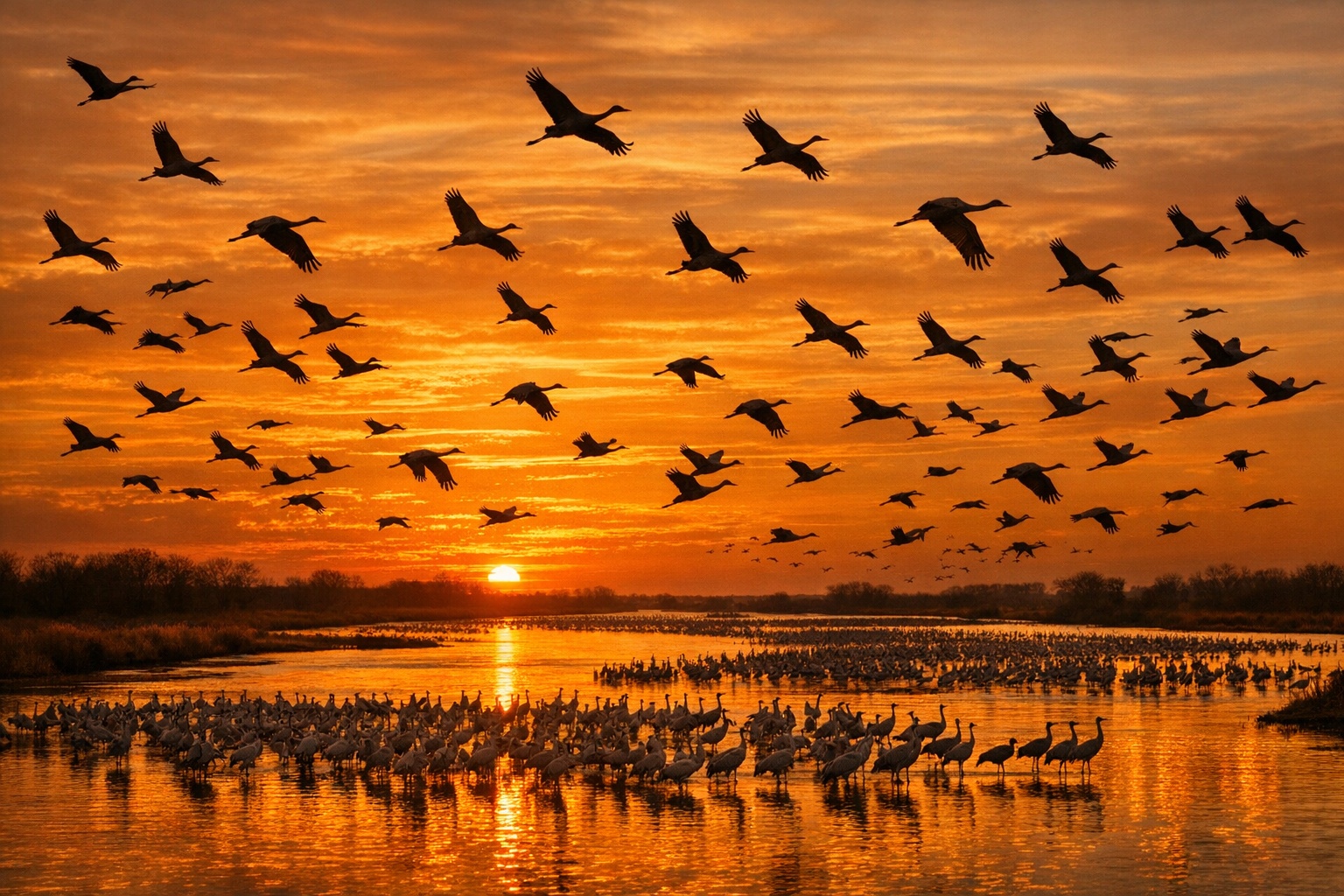
Thousands of sandhill cranes in flight over the Platte River at sunset

How to Experience the Crane Migration

The sandhill crane migration along Nebraska's Platte River is one of the world's great wildlife spectacles — and one that is remarkably accessible to ordinary travelers. Here is how to make the most of this extraordinary natural event.

The cranes typically begin arriving in late February, with numbers building through early and mid-March. The absolute peak — when the largest numbers of birds are present simultaneously — generally occurs between March 10 and March 25, though this varies year to year based on weather and conditions along the migration route. By mid-April, most cranes have moved on to their northern breeding grounds.

There are two primary types of viewing opportunities: public viewing areas along the Platte River (free, accessible at any time, but with greater distances from the birds) and organized blind tours operated by the Rowe Sanctuary and Crane Trust (fee-based, advance reservation required, provides intimate close-up viewing from positions directly on the river).

  • Book Rowe Sanctuary blinds 3–4 months in advance for peak weeks
  • Stay in Kearney for best central location to multiple viewing areas
  • Plan for sunrise AND sunset viewings — both are spectacular
  • Dress in layers — March mornings on the Platte are cold!
  • Silence is required inside blinds — the experience rewards patience
  • Watch for rare whooping cranes mixed among the sandhill flocks

What to Eat in Nebraska

Nebraska's culinary scene is defined by exceptional beef, pioneering farm-to-table cooking, Czech and German heritage baking, and a restaurant culture in Omaha and Lincoln that has earned national attention.

Nebraska Beef – The Real Thing

Nebraska is consistently one of the top three beef-producing states in America, and the quality of the beef produced here is extraordinary. Nebraska feedlots finish cattle on carefully controlled corn-based diets that produce the marbling and flavor characteristics of some of the world's finest beef. When you eat a steak in Nebraska — particularly in Omaha, which was once one of the nation's great livestock processing centers — you are eating beef of a quality that restaurant-goers in coastal cities pay premium prices to approximate.

Omaha's steakhouse culture is legendary among food enthusiasts. Restaurants like Gorat's, Anthony's, and Johnny's Café have been serving extraordinary steaks for generations, and a new wave of upscale steakhouses has added contemporary preparation techniques and wine programs to the city's already formidable beef tradition. A porterhouse or prime rib dinner at a classic Omaha steakhouse is one of the most satisfying culinary experiences the American Midwest has to offer.

Beyond the steakhouse tradition, Nebraska beef appears throughout the state's food culture in burgers, barbecue, sandwiches, and the beloved "runza" — a Nebraska-specific hand-held pastry filled with seasoned ground beef, cabbage, and onions that has its origins in the state's Volga German immigrant heritage. The Runza restaurant chain, which serves this uniquely Nebraskan sandwich, operates dozens of locations across the state and is as authentically Nebraskan as anything you will encounter on your travels.

Omaha's Restaurant Revolution

Omaha has undergone a genuine culinary transformation over the past two decades, evolving from a steak-and-potatoes city into one of the most exciting restaurant markets in the Midwest. The Old Market district, Dundee neighborhood, Midtown Crossing, and the Blackstone neighborhood have all emerged as dining destinations with competitive, creative, and diverse restaurant scenes.

James Beard Award-nominated chefs have brought national attention to Omaha's food culture, and the city now boasts exceptional offerings in Japanese (ramen to sushi), Korean, Indian, Ethiopian, Somali, Vietnamese, Mexican, Middle Eastern, and contemporary American cuisines. The diversity reflects Omaha's growing immigrant community, which has profoundly and positively transformed the city's cultural and culinary landscape.

Lincoln's Haymarket district offers a similarly vibrant dining scene on a somewhat smaller scale, with particular strength in farm-to-table American cooking, craft beer and cocktails, and an independent coffee culture that supports several excellent specialty roasters. The Saturday Haymarket Farmers' Market is a culinary event in itself — a fantastic place to sample Nebraska-grown produce, artisan cheeses, fresh-baked goods, and locally cured meats.

🥩 Nebraska Dining Essentials

Must-try foods: Runza sandwich, Omaha prime rib, Val's Burgers, kolache pastry (Wilber), Valentino's pizza (Lincoln), Mahogany Prime Steakhouse, and any item at an Omaha Farmers' Market vendor.

Young woman enjoying coffee at an outdoor cafe in Lincoln Nebraska

Lincoln & Omaha: Café Culture & City Living

Nebraska's two major cities have developed genuine café cultures that reward the slow traveler who prefers to sit and soak in the energy of a place rather than racing between attractions. The café and coffee scenes in Lincoln and Omaha reflect the cities' substantial university populations, their growing creative and tech industries, and their increasingly diverse communities.

In Lincoln, the Haymarket district's concentration of independent coffeehouses — each with its own aesthetic, music, and crowd — makes it one of the most enjoyable places in the Midwest to spend a leisurely morning with a book or laptop. Coffee shops like Cultiva, Single Barrel, and Narrative Coffee compete on quality and character, serving single-origin pour-overs and expertly crafted espresso drinks that would earn respect in Portland or Brooklyn.

Omaha's café scene is spread across its diverse neighborhoods, from the studious independent shops near the university campuses to the design-forward establishments in the Blackstone neighborhood and the Old Market. The city's growing tech sector has created a daytime café culture of considerable energy, with professionals and creatives filling the city's best coffee establishments throughout the working week.

  • Lincoln's Haymarket: Best concentration of independent cafés
  • Omaha's Blackstone neighborhood: Trendy café scene with cocktail bars
  • Both cities offer excellent craft beer scenes with 15+ local breweries
  • Nebraska's Great Plains Coffee Roasters: A specialty roaster worth seeking out

Where to Stay in Nebraska

Nebraska offers accommodations at every price point and style, from international hotel brands and boutique urban hotels to working ranch stays and riverside cabins.

Omaha Hotels & Neighborhoods

Omaha offers an excellent range of accommodation options centered primarily in the downtown core and Old Market district, with additional clusters near the Henry Doorly Zoo and along the Dodge Street corridor in Midtown. For the most convenient access to the city's best restaurants, bars, and cultural institutions, staying in or near the Old Market is the ideal choice. The neighborhood features several boutique hotels occupying historic buildings that provide distinctive character alongside modern amenities.

Business travelers and those seeking full-service luxury will find reliable options with major brands including The Marriott at the Convention Center, the Kimpton Cottonwood Hotel (one of the best hotels in Nebraska, occupying a beautifully renovated 1920s building), and the DoubleTree by Hilton Omaha Downtown. Budget-conscious travelers have numerous reliable chain options along the highway corridors in Omaha's suburbs, with easy interstate access to downtown.

Lincoln Accommodation Options

Lincoln's accommodation market is concentrated near the University of Nebraska campus and in the downtown-Haymarket area, with the most atmospheric options in the latter. The Graduate Hotel Lincoln, occupying a prime position near the Haymarket, is designed specifically for the university town market and offers a stylish, locally themed environment that captures Lincoln's collegiate energy. The boutique Cornerstone Mansion Bed and Breakfast offers a more intimate option in a beautifully preserved Victorian home.

Football season (September through November) sees Lincoln's accommodation capacity under extreme pressure for home game weekends. Rooms within 30 miles of Lincoln typically sell out months in advance for Nebraska Huskers home games, and prices rise significantly during these periods. Plan well in advance if your visit coincides with a home game — or embrace the chaos and try to find accommodation in small towns along I-80 if downtown Lincoln is full.

Unique Nebraska Lodging Experiences

For the most authentically Nebraskan accommodation experience, look beyond conventional hotels to the state's growing supply of distinctive lodging options. Working cattle ranches in the Sandhills that accept guests offer an incomparably immersive introduction to the region's culture and landscape. Guests typically share meals with the ranch family, participate in (or simply observe) ranch work, explore the dunes on horseback, and spend evenings under some of the most spectacular night skies in America.

Cabins and vacation rentals along the Niobrara River near Valentine provide excellent bases for canoe trips, wildlife viewing, and Sandhills exploration. Lake McConaughy offers extensive cabin and RV facilities along its sandy shores, ideal for families who want to combine swimming, fishing, sailing, and birdwatching in a single location. The state park system operates excellent cabin facilities at several parks, including Fort Robinson, Chadron, and Indian Cave, that provide comfortable rustic lodging at highly affordable rates.

Camping in Nebraska

Nebraska's state park camping system is excellent and among the most affordable in the Midwest. The state's 76 state park and recreation areas offer a wide range of facilities from primitive tent sites to full-hookup RV pads, and most include modern restroom and shower facilities, well-maintained picnic areas, and direct trail access. Nebraska state park camping permits cost a fraction of equivalent facilities in western national parks, and advance reservations through the Nebraska Game and Parks Commission website are straightforward and reliable.

For dispersed camping and the maximum wild experience, the Nebraska National Forest at Halsey and the surrounding Bessey Ranger District offer opportunities to camp among the hand-planted ponderosa pines under some of the darkest skies available to campers east of the Rocky Mountains. The forest's trails connect to views of the surrounding Sandhills that are unlike anything else in the American interior.

Practical Nebraska Travel Tips

Make your Nebraska trip smooth and memorable with these practical insights covering everything from weather preparation to driving etiquette.

🌩️

Weather Preparedness

Nebraska weather can change dramatically and quickly. Always monitor NOAA weather alerts, particularly from May through August when severe thunderstorms and tornadoes are possible. Carry a battery-powered weather radio or download the NOAA Weather app.

🚗

Driving Etiquette

Move over for farm equipment on rural roads — it's both polite and legally required. Be alert for deer at dawn and dusk, especially in eastern Nebraska's wooded areas. Watch for gravel on state highways in rural counties.

💧

Stay Hydrated

Nebraska summers are hot and often windy. The wind on the open plains accelerates dehydration even when temperatures feel comfortable. Carry more water than you think you need, especially during outdoor activities in summer.

🦟

Bug Season

Mosquitoes can be significant near water from June through September. Pack insect repellent and consider light long-sleeved clothing for evening activities near rivers, lakes, or wetlands. Ticks are present in wooded and grassy areas — check carefully after outdoor activities.

📱

Cell Service

Cell coverage is excellent in and around cities and along major highways, but can be limited or absent in the Sandhills and remote Panhandle areas. Download offline maps (Google Maps or Maps.me) before venturing into remote areas. Tell someone your planned route and expected return time.

🏪

Small Town Services

In the Sandhills and western Nebraska, towns can be 50–80 miles apart. Fill up with gas whenever you find a station, carry extra water in your vehicle, and check opening hours before counting on services in very small communities — many businesses may be closed on Sundays.

🌅

Sunrise & Sunset Times

Nebraska's unobstructed horizons make sunrises and sunsets absolutely spectacular. Check sunrise/sunset times before activities — the golden hour light transforms the landscape and creates the best photography conditions throughout the state.

🧭

State Parks Pass

An annual Nebraska State Park Permit costs approximately $30 for in-state and $50 for out-of-state vehicles and provides access to all 76 state park areas. If you plan to visit more than 2–3 parks, it pays for itself quickly and supports Nebraska's excellent park system.

What to Pack for Nebraska

Nebraska's varied climate, terrain, and activities require thoughtful packing to ensure comfort and safety across a wide range of conditions.

Clothing Essentials

Nebraska's weather is famously variable, and the old saying about it perfectly applies: "If you don't like Nebraska weather, wait five minutes." Even in summer, temperatures can swing dramatically within a single day — a 95°F afternoon can be followed by a 60°F evening after a thunderstorm. Layering is the fundamental strategy.

For spring visits (crane migration season), pack warm base layers, a mid-weight fleece or down jacket, waterproof outer layer, warm hat, and gloves for early morning viewings. River blinds at dawn in March are genuinely cold. Comfortable walking shoes are essential, and waterproof boots are useful if you plan to walk near wetlands or along the river.

Summer visitors should prioritize lightweight, breathable, sun-protective clothing. Wide-brimmed hats and high-SPF sunscreen are essential — the Nebraska sun on open plains is intense and relentless. Evenings cool down pleasantly in most of the state, making a light jacket or long-sleeved shirt useful even in July.

Fall is arguably Nebraska's most forgiving season for packing — mild temperatures in the 50s–70s°F for most of September and October mean that a simple mix of light layers, jeans, and comfortable shoes handles most conditions. Pack a rain layer for occasional autumn storms.

🎒 What Never to Leave Home Without

Sunscreen (SPF 50+), insect repellent, reusable water bottles (large!), offline maps downloaded, binoculars (wildlife viewing), camera, cash for small-town businesses that may not accept cards.

Gear for Outdoor Activities

If your Nebraska itinerary includes hiking, the terrain is generally moderate, and standard trail running shoes or lightweight hiking boots are adequate for most maintained trails. The more rugged terrain at Scotts Bluff and Toadstool Park benefits from proper ankle support, and the loose gravel of the Scotts Bluff summit trail makes grip important.

For birding and wildlife viewing — particularly during crane migration — a good pair of binoculars (8x42 or 10x42 recommended) will enormously enhance the experience. A spotting scope is worth bringing for crane viewing if you have one. Long-lens camera equipment rewards the patient wildlife photographer with extraordinary opportunities throughout the state.

Canoe and kayak trips on the Niobrara River are easily arranged through rental outfitters in the Valentine area, so you do not need to bring your own watercraft. Do bring water shoes, dry bags for electronics, sunscreen, and a light windbreaker for river trips — the Niobrara canyon is beautiful but can be breezy and cool even in midsummer.

Technology & Connectivity

Portable battery packs are strongly recommended for any trip into rural Nebraska, where charging opportunities may be limited and cell coverage can reduce your phone's battery life as it continuously searches for signal. A dedicated GPS device is a useful backup in areas with limited cellular connectivity.

For photography enthusiasts, Nebraska rewards those who come prepared. The sunrises and sunsets over the Great Plains are genuinely world-class photographic subjects, and the crane migration offers once-in-a-lifetime wildlife photography opportunities. A wide-angle lens for landscape work and a telephoto (at least 300mm) for wildlife and cranes will serve you well.

Transportation in Nebraska

Flying to Nebraska

Eppley Airfield in Omaha (OMA) is Nebraska's primary international airport, served by American Airlines, Delta, United, Southwest, and several regional carriers with direct flights to most major US hub cities. The airport is compact, efficient, and well-located just 10 minutes from downtown Omaha. Lincoln Airport (LNK) offers a more limited but growing schedule of direct flights, primarily on American and United, and is a convenient entry point for travelers whose primary destinations are Lincoln and central Nebraska.

Rental car companies operate at both airports, and securing a vehicle immediately upon arrival is essential for exploring beyond the two cities. Airport rental rates in Omaha and Lincoln are generally competitive with the national average, and all major brands — Enterprise, Hertz, Avis, Budget, National — are represented. Booking in advance, particularly for peak summer and crane migration season travel, ensures availability and the best rates.

Driving Across Nebraska

Interstate 80 is Nebraska's main east-west artery, running from Omaha through Lincoln, Kearney, North Platte, and into Wyoming. The speed limit on Nebraska's rural interstates is 75 mph, and the wide, well-maintained roadway makes long-distance driving comfortable even for those unaccustomed to Great Plains distances. Service plazas along I-80 provide regular access to fuel, food, and restrooms at intervals of roughly 40–60 miles.

For travelers seeking a more scenic alternative to the interstate, US Highway 20 runs the length of the state through its northern tier, passing through the Sandhills, Valentine, the Niobrara Valley, and the Pine Ridge region of the Panhandle. This route adds significant driving time compared to I-80 but rewards patient travelers with some of Nebraska's most spectacular landscapes and most authentic small-town experiences. US Highway 26 traverses the North Platte River valley through the Panhandle, offering a beautiful approach to Scotts Bluff and Chimney Rock.

Ground Transport in Omaha and Lincoln

Within Omaha, the Metro Area Transit bus system provides coverage of major neighborhoods and attractions, but service frequency and hours can be limiting for visitors. Rideshare services (Uber and Lyft) operate throughout the Omaha metropolitan area with reliable availability, and this is the most practical option for visitors who prefer not to drive in the city. Downtown Omaha and the Old Market district are walkable, and the Missouri Riverfront trail system provides excellent cycling infrastructure connecting the waterfront areas.

Lincoln is similarly served by a municipal bus system and rideshare services, and the city's compact downtown-university area is highly walkable during the academic year. Lincoln's protected bike lane network has expanded significantly in recent years, and several bike-share stations near campus and the Haymarket provide convenient on-demand cycling for short trips. The Bison Trail and Mopac Trail systems offer longer-distance cycling paths connecting Lincoln to surrounding communities.

Travel Guide: Common Questions

Nebraska is one of the safest states in the US for travelers. Violent crime rates are well below national averages in rural areas and small towns, which comprise the vast majority of the state's land area. Omaha has some urban crime areas typical of any mid-sized American city, but tourist areas like the Old Market are well-policed and generally very safe. The primary safety concerns in Nebraska are weather-related: severe thunderstorms, tornadoes (May–August), winter blizzards, and summer heat.
Nebraska is one of the most affordable travel destinations in the United States. Hotel rates in Omaha and Lincoln average 20–30% below comparable rooms in coastal cities. Restaurant meals, even at high-quality establishments, are generally very reasonable. Gas prices are typically below the national average. State park fees are nominal. A well-planned week-long Nebraska vacation can be accomplished on a budget that would cover only a few days in New York, San Francisco, or Chicago.
Nebraska is most widely known for agriculture (particularly corn and cattle), the Oregon Trail, Huskers football, Warren Buffett (who was born in Omaha and still lives there), and the spectacular sandhill crane migration. Less widely known but equally impressive: the Henry Doorly Zoo (one of the world's best), the extraordinary Sandhills landscape, Chimney Rock, and a growing restaurant and arts scene in Omaha and Lincoln that rivals much larger cities.
For meaningful exploration of Nebraska beyond its two major cities, a car is essential. Omaha and Lincoln are navigable without a car using rideshare services and public transit, but reaching natural attractions like Chimney Rock, the Sandhills, Lake McConaughy, and the Niobrara River requires personal transportation. The state is vast and public transport between regions essentially non-existent. Budget for a rental car as a fundamental trip expense.
For the crane migration, late February through mid-April is the obvious answer. For general travel with the best balance of weather, activities, and value, September and October are hard to beat — the temperatures are pleasant, the football season is in full swing in Lincoln, harvest festivals abound, and fall colors illuminate the river valleys. May, June, and early July are also excellent for wildflowers, camping, and water recreation before peak summer heat arrives.

Your Nebraska Adventure Awaits

We hope this guide helps you plan an extraordinary trip to the Cornhusker State. Nebraska rewards every traveler who comes with open eyes and genuine curiosity. Start planning today.

Explore Nebraska's Destinations